How Long Does It Take to Get CCNP Certified?
 Sep 10, 2026
 01:49 AM
If you're weighing whether to go after your CCNP, you've probably already searched some version of "how long will this actually take me?" The honest answer: it depends. Some people get there in three months. Others need a year or more. Neither of those learners is doing it wrong they just started from different places. Your timeline comes down to a handful of things: how solid your networking fundamentals already are, how much hands-on experience you've had, how much time you can realistically study each week, which CCNP track and concentration you choose, and how you personally learn best.
For CCNP Enterprise specifically, Cisco requires two exams one core exam and one concentration exam. The core is 350-401 ENCOR, and you pick your concentration from Cisco's list of Enterprise options. There's no formal prerequisite, so technically you could sign up tomorrow. Whether you should is a different question, and that's what this guide is really about.
If you're exploring professional networking training in Dallas, understanding what the exams actually require before you commit to a study plan will save you a lot of wasted effort.
What Is CCNP?
CCNP stands for Cisco Certified Network Professional it's Cisco's professional-level certification, sitting above CCNA and validating deeper, more advanced networking skills.
CCNP covers several different technology tracks. This guide focuses on CCNP Enterprise, one of the most common paths for people building a career in enterprise networking. Here's what Cisco's current structure looks like:
- Core exam: 350-401 ENCOR
- Concentration exam: one approved Enterprise concentration exam
- Prerequisites: none, formally
- Validity: three years
ENCOR covers a lot of ground — enterprise infrastructure, dual-stack IPv4/IPv6 architecture, virtualization, network assurance, security, and automation. The concentration exam is where you specialize, whether that's advanced routing, SD-WAN, network design, automation, cloud connectivity, or assurance.
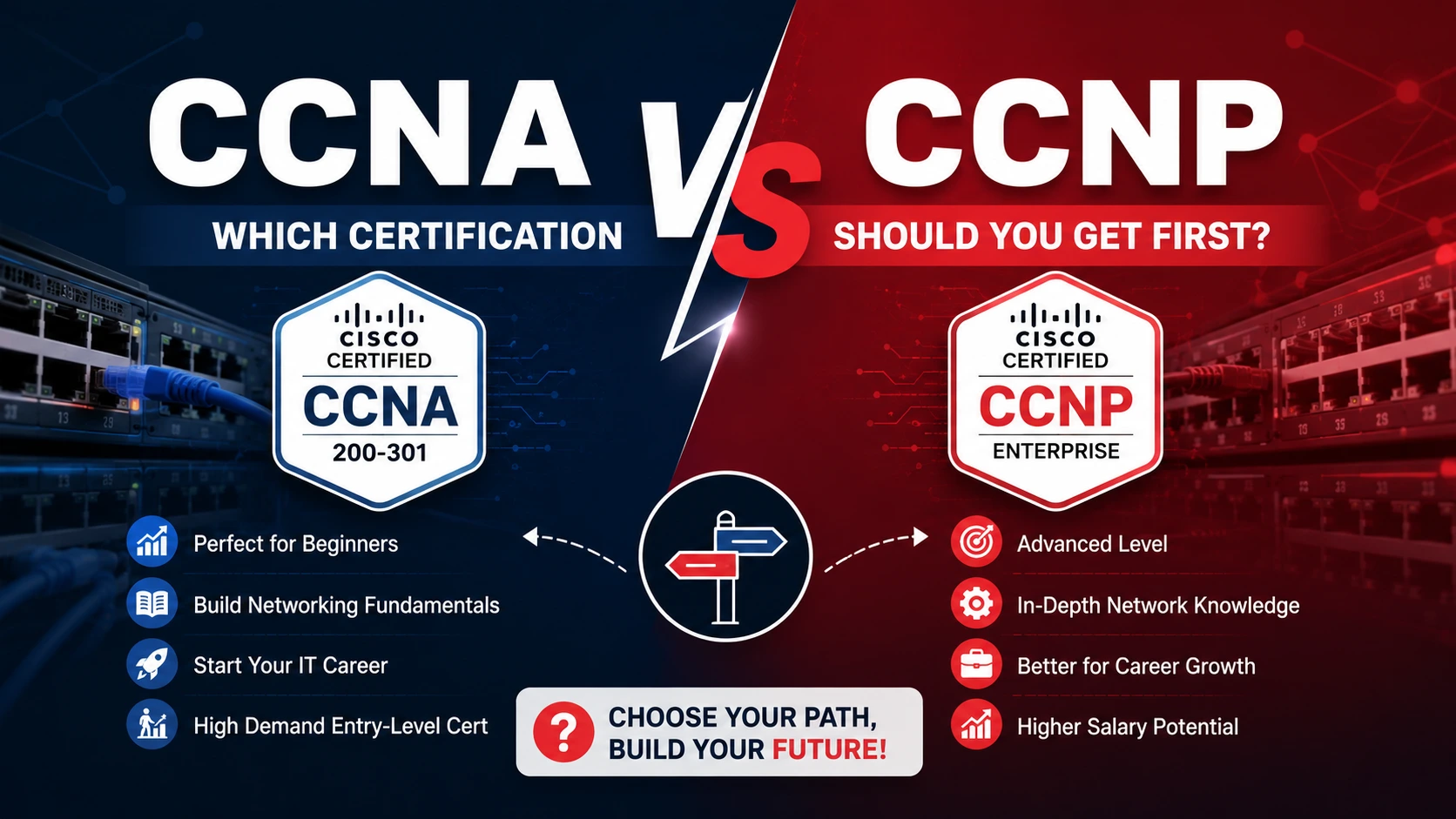
Still deciding between CCNA and CCNP? Our guide, CCNA vs CCNP: Which Certification Should You Get First?, walks through how to choose.
Do You Need CCNA Before Attempting CCNP?
No — Cisco doesn't require it. There's no formal prerequisite listed for the CCNP Enterprise exams.
But "no formal prerequisite" doesn't mean "no prior knowledge needed." CCNP material assumes you're already comfortable with things like:
- IP addressing and subnetting
- Routing and switching concepts
- TCP/IP fundamentals
- VLANs
- Network troubleshooting
- Basic network security
- Enterprise networking concepts
- Basic automation concepts
If several of these feel shaky, it's worth strengthening them before diving into CCNP material — otherwise you'll end up learning CCNA-level concepts and CCNP-level concepts at the same time, which slows everyone down. Structured CCNA training in Dallas can help build that base first.
Breaking Your CCNP Preparation Into Stages
Big goals feel more manageable in stages. Here's how a typical CCNP journey breaks down.
Stage 1: Assess What You Already Know (1–2 weeks)
Before opening a single study guide, be honest with yourself about where you stand. Ask:
- Can I subnet confidently, without a calculator?
- Do I understand how routing protocols make decisions?
- Can I troubleshoot a connectivity problem systematically?
- Do I understand VLANs and segmentation?
- Have I worked with real enterprise networking equipment?
- Do I understand basic network security concepts?
If you're answering "no" to several of these, that's not a red flag — it's useful information. Budget extra time for fundamentals now, and you'll move faster later.
If you're coming from a support role, our guide What Does a Tech Analyst Do? A Complete Guide in 2026 covers the foundational IT skills that often lead into networking careers.
Stage 2: Build Your CCNP Foundation (4–8 weeks)
This is where you build real understanding of the technologies your track covers — for CCNP Enterprise, that means enterprise architecture, virtualization, infrastructure, network assurance, security, automation, IPv4/IPv6, routing, and wireless connectivity.
Resist the urge to memorize commands. Focus instead on why a technology exists, when you'd reach for it, and how you'd troubleshoot it when it breaks. That distinction matters a lot more at the professional level than it did for CCNA.
Stage 3: Choose Your Concentration Exam (1 week to decide, longer to prepare)
Your concentration should line up with where you want your career to go, not just what sounds interesting. Cisco's current Enterprise concentration options include:
- 300-410 ENARSI – Advanced Routing and Services
- 300-415 ENSDWI – Cisco Catalyst SD-WAN Solutions
- 300-420 ENSLD – Enterprise Network Design
- 300-435 ENAUTO – Enterprise Automation and Programmability
- 300-440 ENCC – Secure Cloud Connectivity
- 300-445 ENNA – Enterprise Network Assurance
This list can change, so double-check current options directly with Cisco before you commit. Someone drawn to deep troubleshooting and routing work might lean toward ENARSI; someone aiming at automation or cloud-connected environments might pick differently.
Stage 4: Get Your Hands Dirty With Labs (4–8 weeks, often overlapping with study)
Reading and watching videos will only get you so far — networking is a hands-on discipline. Spend real time:
- Configuring routing protocols
- Troubleshooting connectivity issues you created yourself
- Working through IPv4/IPv6 scenarios
- Building out enterprise network topologies
- Diagnosing configuration mistakes
- Reviewing packet flow and traffic behavior
A good lab environment is where you're allowed to break things safely — which is exactly how the concepts start to stick. If self-directed study isn't your strength, structured, instructor-led training can help here. DFW IT Career's CCNP Training Course in Dallas is built around this kind of hands-on, scenario-based learning, currently structured as six modules across 88 lessons.
Stage 5: Practice Exams and Targeted Review (2–4 weeks)
Once the core material is in place, shift from learning to testing yourself. Practice questions are useful, but don't just memorize answer patterns — for every question, ask yourself why the correct answer is correct. If you can't explain it, that's your real weak spot, not the topic the question happened to be about. Keep a running list of weak areas and revisit them before you book your exam date.
Stage 6: Take the Exams
For CCNP Enterprise, you'll sit both the core exam and one concentration exam — though not necessarily on the same day. Many candidates prepare thoroughly for ENCOR, take it, then shift full focus to the concentration exam.
As of this writing, the 350-401 ENCOR exam runs 120 minutes and costs US$400, while the Enterprise concentration exams are generally 90 minutes at US$300. Exam pricing and formats can change, so verify current details with Cisco before booking.
A Realistic 6-Month CCNP Study Plan
If you already have CCNA-level knowledge plus some hands-on experience, six months is a workable target. Here's roughly how it might break down:
- Month 1 — Review the fundamentals: routing, switching, IPv4/IPv6, subnetting, troubleshooting.
- Month 2 — Core ENCOR topics: architecture, infrastructure, virtualization, assurance, security, automation.
- Month 3 — Advanced ENCOR + labs: stop reading about configurations and start building them.
- Month 4 — Concentration focus: shift attention to your chosen concentration exam (e.g., deeper routing work for ENARSI).
- Month 5 — Labs and practice exams: combine hands-on work with practice testing and weak-area review.
- Month 6 — Final review and exam: close remaining gaps, and schedule once you can explain concepts without leaning on memorized answers.
Can You Get CCNP Certified in 3 Months?
Yes — for the right person. Three months is realistic if you already work in networking, have strong routing and switching knowledge, have real hands-on experience, can study consistently, and have access to decent labs.
It's a much tougher ask for someone brand-new to networking. Forcing a three-month timeline when your situation really calls for six or nine can backfire — a failed attempt costs you money and, more importantly, tells you which parts of your preparation still need work. The better question isn't "how fast can I finish?" It's "am I actually ready to demonstrate professional-level knowledge?"
Can You Get CCNP Certified in 6 Months?
For most learners with some existing networking foundation, yes — and consistency matters more than intensity here. A workable rhythm might look like:
- 1–2 hours of study on weekdays
- 2–4 hours on weekends
- Regular lab sessions
- A weekly review session
- Practice exams toward the end
Adjust this around your actual life — work, family, and how quickly you personally absorb new material all matter more than any generic schedule.
What If You Have No Networking Experience at All?
Don't feel pressured to jump straight into CCNP. A more sustainable path usually looks like:
IT fundamentals → networking fundamentals → CCNA-level knowledge → hands-on experience → CCNP
An entry-level IT support role can be a genuinely useful stepping stone, giving you real exposure to troubleshooting, operating systems, and user-facing networking issues before you tackle professional-level material. Our article How Dallas Companies Value Help Desk Professionals covers how that kind of experience builds toward more advanced IT careers, and our Tech Analyst (Help Desk) Training Course is worth a look if you're still building your foundation.
Does Hands-On Experience Actually Make CCNP Easier?
Generally, yes. There's a real difference between reading about a routing failure in a textbook and actually troubleshooting one yourself. When you're in the lab, you're forced to work through:
- What changed?
- What should be happening?
- What's actually happening?
- Where is the failure occurring?
- Which command or tool will confirm it?
- What fix actually resolves it?
That problem-solving loop is exactly the skill CCNP is trying to validate, and it's also what makes you useful on the job afterward.
How Much Should You Study Each Day?
There's no official requirement, and honestly, more hours isn't automatically better. For a working professional, 1–2 focused hours a day combined with consistent lab time can add up faster than you'd expect. Full-time students may have room for more.
What matters more than hours logged is what you can actually do. "I studied for 100 hours" doesn't tell you much. "I can configure, troubleshoot, and explain the technologies on my exam" does — and it's a far better gauge of whether you're ready.
What Can Make Your Preparation Take Longer?
A few common culprits:
- Weak fundamentals — shaky subnetting, routing, or switching knowledge will slow down everything built on top of it.
- Limited hands-on practice — concepts stay abstract without a lab to test them in.
- Inconsistent study habits — a heavy weekend followed by two weeks off hurts retention badly.
- Memorizing instead of understanding — this catches up with you fast at the professional level.
- Choosing the wrong concentration — pick one that matches your actual interests and experience, not just what seems easiest.
- A demanding full-time job — this isn't a failure, it's a reality. A longer, more sustainable timeline often beats a rushed one.
How CCNP Fits Into a Broader IT Career
CCNP isn't the only road into a strong IT career. Some professionals start in help desk roles and work their way into networking; others come in through cybersecurity, systems administration, cloud infrastructure, or DevOps. Networking knowledge pairs naturally with several of these paths — for example, our guide Top Cyber Security Certifications to Boost Your Career in Dallas covers a related direction, and How to Build a Career in IAM: Step-by-Step Guide explores identity and access management as another option.
Networking also connects closely with automation and modern IT operations, which is worth exploring through our DevOps Engineering program if your long-term goals extend beyond traditional networking roles.
Other areas that often complement a networking career include cybersecurity, cloud computing, network automation, DevOps, data and analytics, AI, and enterprise collaboration technologies. None of these are prerequisites for CCNP, but understanding how they connect can help you see the bigger picture of where your career could go.
Why Consider Structured CCNP Training?
Self-study absolutely works for some people. For others, having a structured curriculum, instructor support, guided labs, and a clear roadmap makes the process far less overwhelming — especially at the professional level, where the material gets genuinely complex.
DFW IT Career's CCNP Training Course in Dallas is built around advanced networking concepts, hands-on labs, and real enterprise scenarios, currently structured as six modules across 88 lessons. The course is led by Usman Cheema, a Cisco CCNA and CCNP instructor with extensive experience in Cisco collaboration and data-center architecture, including CCIE-level certifications — the kind of background that helps when you're working through concepts that are genuinely hard to grasp from theory alone.
That said, no training provider — including us — can guarantee you'll pass an exam or land a specific job. Your outcome depends on your preparation, hands-on ability, and how well your skills match what individual employers are looking for.
Frequently Asked Questions
How long does it take to get CCNP certified?
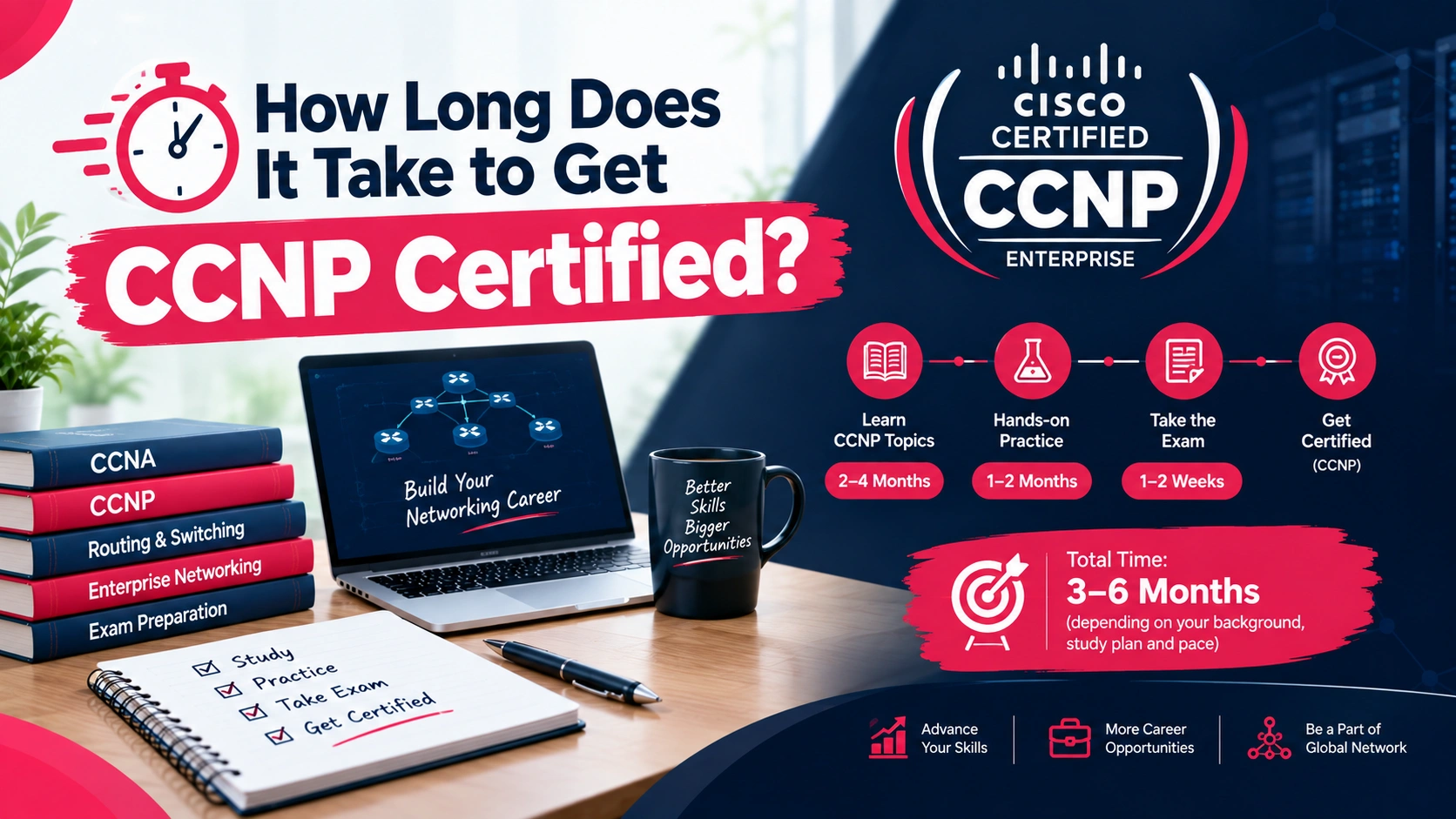
Roughly 3–6 months if you already have solid networking knowledge and experience. Beginners often need 6–12 months or more.
Can I get CCNP in 3 months?
Yes, if you already have strong fundamentals, hands-on experience, and enough weekly study time. It's a much harder timeline for beginners.
Do I need CCNA before CCNP?
No — Cisco doesn't require it as a formal prerequisite. That said, CCNA-level knowledge gives you a solid foundation for professional-level study.
How many exams does CCNP Enterprise require?
Two: one core exam and one concentration exam.
What is the CCNP Enterprise core exam?
350-401 ENCOR: Implementing Cisco Enterprise Network Core Technologies — a 120-minute exam, per Cisco.
How much does the CCNP Enterprise exam cost?
Cisco currently lists ENCOR at US$400 and Enterprise concentration exams (like ENARSI or ENSLD) at US$300. Always verify current pricing before registering.
Is CCNP worth it?
It can be — particularly for networking professionals aiming to demonstrate professional-level Cisco skills. Its actual value depends on your experience, target roles, and how well you can apply what you've learned.
Can beginners study for CCNP?
Yes, but building strong fundamentals first — through CCNA-level knowledge or foundational IT training — usually makes the process far more manageable.
Final Thoughts: Planning Your CCNP Timeline
So, how long should you actually plan for? A realistic range is 3–6 months if you're already an experienced networking professional, and 6–12+ months or more if you're still building fundamentals and hands-on experience.
Rather than borrowing someone else's timeline, base yours on your own current knowledge, hands-on experience, weekly availability, chosen concentration, and how you perform in practice assessments.
CCNP is a professional-level certification, and the real goal isn't just passing two exams — it's building networking knowledge you can actually use on the job.
If you're ready to move toward professional-level networking, take a look at DFW IT Career's CCNP Training Course in Dallas, and compare it against the CCNA Training Course if you need to strengthen your foundation first. A solid study schedule, real hands-on practice, and consistent effort will get you there — on a timeline that actually fits your life.